August 25, 2026
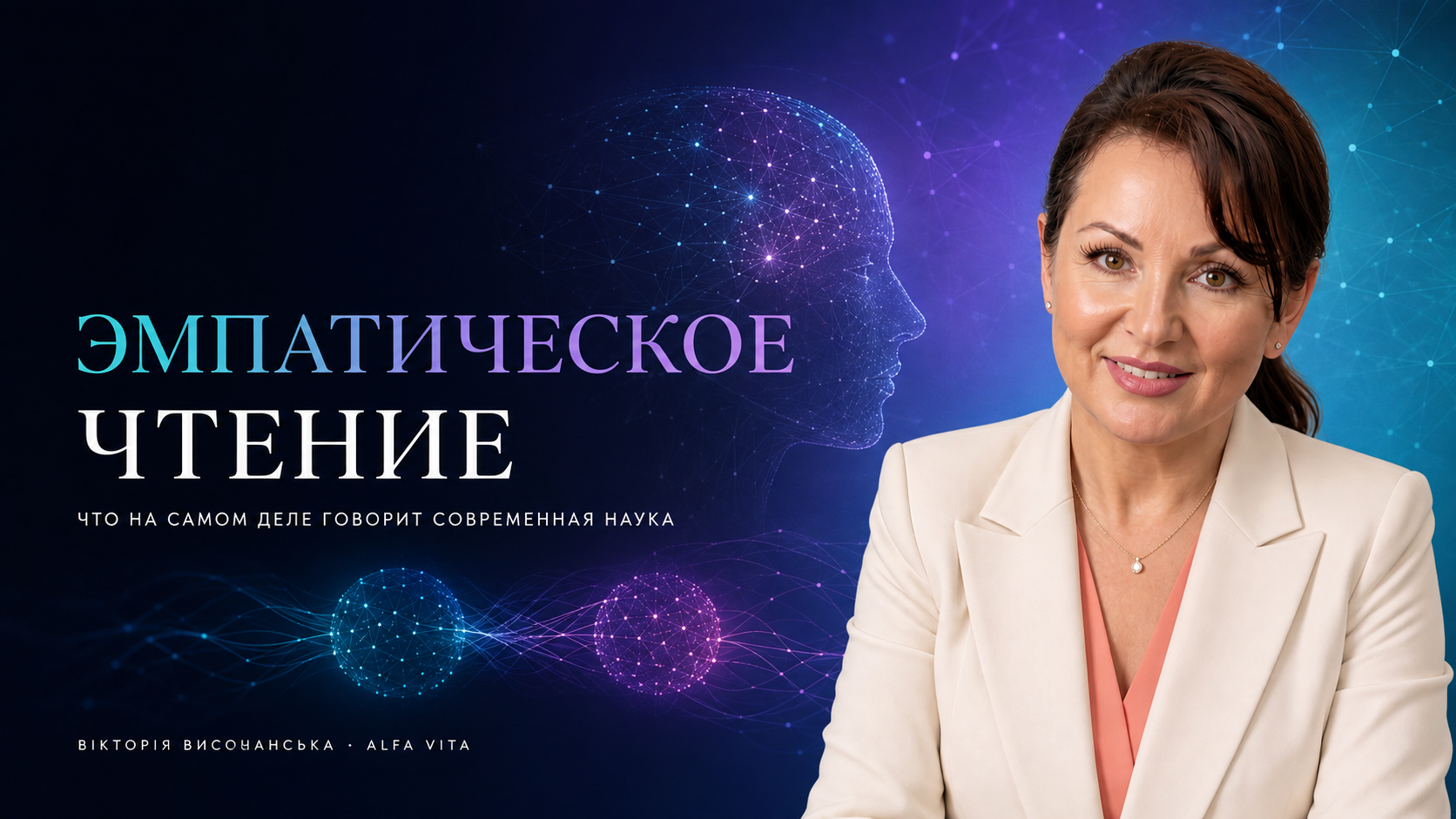
Empathic Reading: What Science Has Proven, and What Remains an Open Question
For many years I have worked with a phenomenon I call empathic reading.
During deep work with a person, I can notice their emotional state, physical tension, inner conflict, fear, or unspoken experience before they describe it to me in detail. Sometimes the information that arises turns out to be far more specific than ordinary observation could account for.
And here a natural question arises: what part of this can be explained by contemporary psychology and neuroscience, and what still remains a research question?
For me, this question is fundamental. I have no interest in proving the unusual at any cost. Quite the opposite. If we talk about the Alfa Vita method as a system for studying the human being, we need to draw a very clear line between what science has already confirmed and what remains hypothesis, personal experience, or a phenomenon whose mechanism is still unknown.
That is exactly why, instead of the familiar word "telepathy," in my professional work I use a more precise concept — empathic reading.
What Empathic Reading Is
Within Alfa Vita, I use the term empathic reading to describe a state of deep attunement to another person, in which the practitioner tracks the information that arises about that person's emotional and physical state, inner conflicts, and unconscious reactions.
Part of this process is well known to contemporary psychology. The scientific literature has a term for it: empathic accuracy — the ability to correctly identify another person's thoughts, feelings, and inner states.
This matters. Empathy is not simply "I feel for you." The human nervous system is constantly reading an enormous amount of information: facial expression, micro-movements, gaze direction, tone of voice, pauses, breathing, posture, shifts in muscle tension, emotional context.
Most of this processing happens so quickly that we don't experience it as a sequential, logical analysis. First comes the sense: "something is happening with this person." Only afterward does the conscious mind try to explain how we knew.
Research on empathy does show that perceiving another person's state is linked to distributed neural systems involved both in emotional resonance and in the conscious understanding of another's condition.
Why We Sometimes Feel Another Person Before We Understand Them
This is where the work of the American psychoanalyst and affective-neuroscience researcher Allan Schore becomes especially relevant.
Schore has spent many years studying the role of the right hemisphere in emotional communication, attachment, affect regulation, and the psychotherapeutic relationship. In his model, the right hemisphere plays a particularly important role in processing nonverbal, emotional, holistic, and implicit social information.
In other words, a person is capable of processing another person's state before they can rationally articulate: "What exactly did I just notice?"
Schore describes the psychotherapeutic interaction as a process that includes unconscious emotional communication between the right-hemisphere systems of two people. This is very close to what I have observed for years in practical work.
But an important scientific clarification is needed here. Schore does not claim that the right hemisphere has a proven ability to receive information telepathically. His research gives us a neurobiological model of extraordinarily subtle nonverbal, unconscious communication between people — but it is not proof of information transfer through unknown sensory channels.
That is a principled boundary. And a good researcher must maintain it.
Empathy Is Not Mind-Reading
When two people are near each other, an enormous amount of information constantly circulates between them. A person may say, "I'm fine," while their voice, breathing, gaze, and posture communicate something entirely different.
An experienced psychotherapist sometimes notices this almost instantly. We call it intuition. But part of what is subjectively experienced as intuitive knowledge may well be the result of extremely fast unconscious processing of many weak signals.
That's why I don't think it's right to automatically label every unexpectedly accurate perception as telepathy. The simpler explanations need to be ruled out first.
This is one of the core principles of the Alfa Vita method: an experience can be real, but our explanation of that experience can still be wrong.
Where Established Science Ends
But there is a harder question. What happens when the information turns out to be specific and verifiable, and the usual channels for obtaining it have been experimentally ruled out?
This is where we leave the well-studied territory of empathy and move into a far more contested field of research that the scientific literature calls anomalous perception, anomalous information reception, or psi research.
Such research does exist. One of the best-known lines of work is the Ganzfeld experiments, in which researchers tried to determine whether participants could identify hidden information under controlled restriction of ordinary sensory cues.
A recent meta-analysis spanning more than forty years of Ganzfeld research reported a small statistical effect above chance level — the authors estimate the overall effect size at roughly 0.08. But that does not mean science has "proven telepathy." The field's history also includes failed replication attempts: a separate meta-analysis of independent Ganzfeld studies failed to confirm the previously claimed effect.
That's why the accurate scientific formulation sounds different: there is experimental data on anomalous perception that warrants further study, but the mechanism of this phenomenon — and its very interpretation — remains a matter of scientific debate.
For me, that formulation is far more interesting than the categorical "it's proven." Because science doesn't begin with belief. It begins with a question.
Why I Don't Use Quantum Physics as a Ready-Made Explanation
In spiritual literature today it's extremely popular to explain telepathy with words like "quantum entanglement," "nonlocal consciousness," "quantum field." It sounds impressive. But there is an enormous gap between an appealing metaphor and a proven mechanism.
To date, we have no established neurobiological model showing how the human brain could receive specific information from another brain at a distance via quantum entanglement.
So at Alfa Vita, I prefer to say: "I don't yet know the mechanism" — rather than: "I know the mechanism, because it's a quantum field."
For a researcher, acknowledging the limits of one's own knowledge isn't weakness. It's professional honesty.
What About Research into Psi Phenomena?
Parapsychology has a fairly long experimental history. Joseph Banks Rhine at Duke University was among the first to systematically study extrasensory perception using statistical methods. Later came the Ganzfeld experiments, along with research into remote viewing, presentiment, and other proposed forms of anomalous information reception.
Some meta-analyses report statistically significant effects. Other studies have failed to replicate them.
The more recent history of research into Daryl Bem's precognition studies is particularly telling. An earlier meta-analysis of 90 experiments reported a small but statistically significant effect. However, a large modern replication project, involving tens of thousands of participants and hundreds of thousands of trials, failed to reproduce the originally claimed effect.
That's exactly how science works. The result of a single study is the beginning of a conversation, not the end of one.
What About Rupert Sheldrake's Morphic Fields?
Here, too, some clarity is needed. Morphic resonance is an interesting hypothesis, but it is not an established biological mechanism for empathic or remote perception. The scientific literature itself characterizes the experimental claims tied to this concept as largely underverified.
So treating such models as an already-proven explanation of empathic reading would be inaccurate. We can discuss them as hypotheses. But a hypothesis and an established fact are different things.
Why the Blind Protocol Matters So Much to Me
And here we get to the most interesting part. If someone believes they can receive information that cannot be explained by ordinary empathic reading, it is not enough to say: "I felt it — so it must be true." Verification is required.
That's why blind protocols become especially valuable:
the practitioner must not know the person's history in advance;
information must be recorded before any feedback is received;
specific statements must be separated from general impressions;
the original response cannot be revised once the real circumstances become known;
the result must be checked by independent sources.
These are exactly the principles applied in contemporary anomalous-information-reception research: researchers use blind procedures, withhold prior information, and rely on independent evaluation of the data collected. This body of work is not proof of any specific "empathic reading" mechanism, but its methodology shows how unusual claims ought to be tested in the first place.
My Own Experience: From an Impression to a Verifiable Fact
In my practice, there was a case involving the search for a missing person that became especially important to me precisely because the work was done blind. I had no complete information about the situation. During the reading, specific images and reference points emerged: features of the terrain, of buildings, a direction of movement, water, a boat, and other details. Later, according to the search participants, part of that information matched the circumstances in which the person was found.
But I deliberately do not call this case "scientific proof of empathic reading." A single case cannot prove the existence of a new natural mechanism. That would require a pre-registered protocol, independent observers, controls against information leakage, documentation of all hits and misses, and repeated replication of the result.
So for me, this case is not proof. It is a reason to keep investigating. And that distinction matters.
The Most Dangerous Mistake: Confusing a Feeling With a Fact
Empathic reading requires more than heightened sensitivity. It requires discipline.
Our brains are constantly building predictions. We tend to notice coincidences, fill in incomplete information, look for confirmation of our own beliefs, and forget our mistakes. That's why a practitioner must constantly ask three questions:
What did I actually feel? How did I interpret it? What of this can later be independently verified?
These are three different levels. And the more unusual the information, the stricter the verification needs to be.
What We Can State with Reasonable Confidence Today
Contemporary science solidly confirms that humans are capable of recognizing other people's emotional and psychological states. Measurable empathic accuracy exists. Neuroscience shows that complex brain systems are involved in emotional resonance and in understanding another person's condition. Allan Schore's research offers a neurobiological model of deep, implicit, nonverbal communication and of the right hemisphere's particular role in emotional relationships.
At the same time, there is a separate body of experimental literature on anomalous perception and psi, where some statistically interesting results have emerged, but their interpretation and reproducibility remain under discussion.
So between the statements "people are capable of reading each other's states with remarkable subtlety" and "it has been proven that the brain transmits thoughts at a distance," we cannot draw an equal sign today.
The first rests on solid scientific ground. The second remains an open research question.
This Is Exactly Where Alfa Vita Begins for Me
I have no interest in replacing one belief system with another. If a phenomenon exists, it doesn't need to be defended by faith. It needs to be investigated.
When I receive information during an empathic reading, my task is not to convince someone that an invisible world exists. My task is to separate feeling from interpretation, interpretation from assumption, and assumption from verifiable fact.
That's exactly why I increasingly call my work empathic reading rather than telepathy. The term leaves room for two things that matter equally to me: the depth of human perception, and intellectual honesty.
Perhaps future research will show that some forms of human perception genuinely extend beyond the mechanisms we currently understand. Perhaps part of what has been called intuition or telepathy for centuries will turn out to be the result of incredibly sophisticated unconscious processing of ordinary signals. Or perhaps we will discover an entirely different mechanism.
We don't know today. And it is exactly the words "we don't yet know" that open the door to real inquiry. Because science is not the denial of the unknown. But it is also not the conversion of the unknown into an established fact.
For me, empathic reading exists exactly on that boundary — between what the human psyche can already explain, and what we have yet to understand.
Alfa Vita — exploring depth without losing the ability to verify reality.
Learn more about the method and book a consultation