Published: July 8, 2026
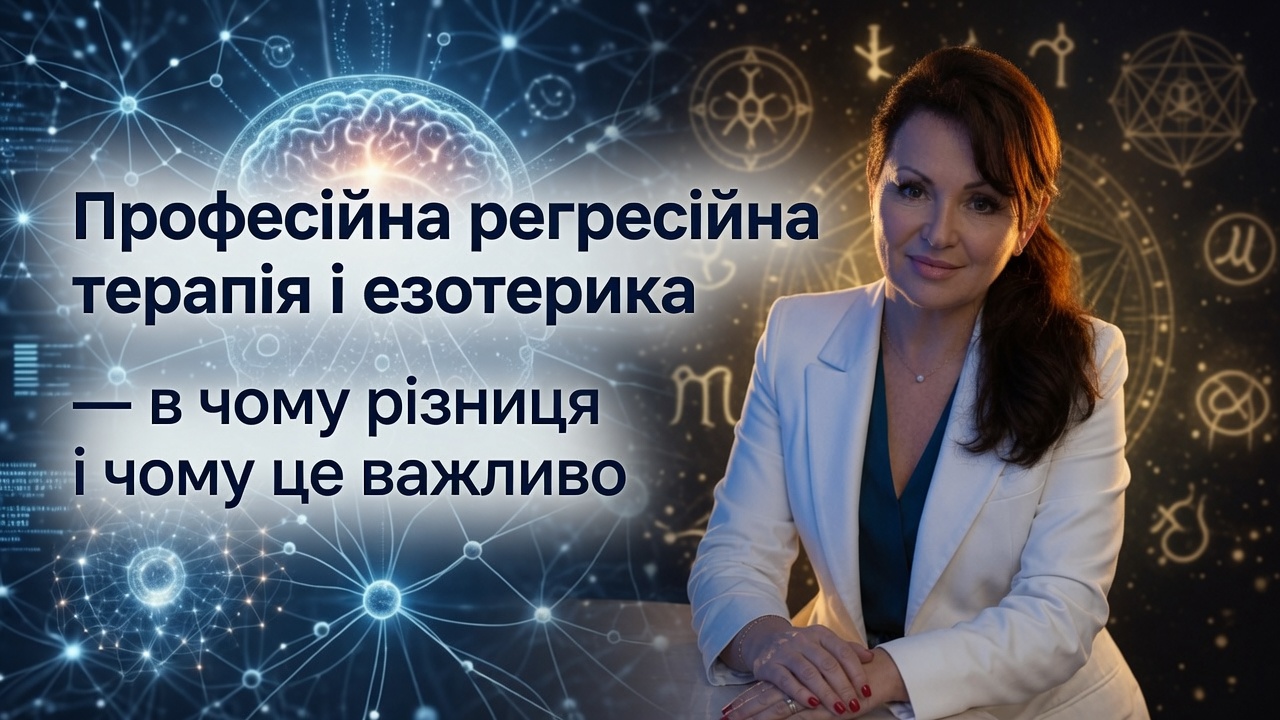
Professional Regression Therapy and Esotericism — What's the Difference and Why It Matters
This material is built on a scientific foundation: right hemisphere neurobiology (Allan Schore, UCLA), systemic family therapy (Bert Hellinger), and analytical psychology (Carl Gustav Jung). The purpose of this article is to outline clear methodological distinctions between scientifically grounded regression therapy and esoteric approaches that use similar terminology but work in fundamentally different ways.
Regression therapy is a method of working with the unconscious, aimed at identifying the root cause of a psychological condition through access to the implicit memory of the right hemisphere of the brain (Allan Schore, «Affect Regulation and the Origin of the Self», 1994).
Today this method is developing in two radically different directions. And the difference between them is not a question of style or personal preference. It is a question of client safety, the reality of results, and the ethics of the practitioner.
Two Directions — Two Different Results
The first direction — esoteric regression. It is based on subjective interpretations, the practitioner's own imagery, and the projection of their material onto the client. The result — an illusion of change without real transformation.
The second direction — professional regression therapy. It is based on precise diagnosis of the root of the problem, a scientific understanding of the mechanisms of the unconscious, and a clear distinction between the therapist's material and the client's material. The result — real change at the level of the unconscious, body, and behavior.
Let us examine the three foundations on which the professional approach rests.
Foundation 1. A Scientific Approach Instead of Guesswork
The scientific approach in regression therapy is an orientation toward the precise identification of the root cause of the client's condition without imposing ready-made interpretive frameworks (Allan Schore, «The Science of the Art of Psychotherapy», 2012).
What this means in practice: clear diagnosis of the source of trauma or unconscious contract — without suggestion and without projecting personal hypotheses. The therapist follows what emerges in the client's field, not what they expect to see. The result is measurable: the client experiences real change in the body, emotional state, and behavior — not simply «feeling better for an hour».
Jung described this principle as the foundation of analytical work: the therapist does not know in advance where the process leads. They follow the client's material — not their own theory (Carl Gustav Jung, «Psychology and Alchemy», 1944).
Foundation 2. Empathic Reading — What It Is and Why It Determines Safety
Empathic reading is the reception of non-verbal affective information through the synchronization of the right hemispheres of the therapist's and client's brains in a state of genuine empathic presence — right brain to right brain communication (Allan Schore, «The Science of the Art of Psychotherapy», 2012).
The Alfa Vita empathic reading method is an original therapeutic approach in which the empathic facilitator enters a state of right-hemisphere resonance with the client, reads the non-verbal, imagistic, and somatic material of the unconscious, and returns it to the client in the form of an image or question for verification — without projecting personal material and without interpretation (Victoria Vysochanska, Alfa Vita, 2026).
This is not an esoteric concept. It is a neurobiologically described mechanism: the right hemisphere of the therapist, in a state of open receptivity, gains access to the non-verbal, imagistic, somatic material of the client — that which the client cannot yet articulate verbally.
This mechanism is the foundation of safe navigation in the depths of the unconscious. The empathic therapist clearly distinguishes: here is the client's material, here is my own. This distinction is not a question of talent. It is a question of training, personal therapy, and supervision.
Foundation 3. The Algorithm of the Psyche — Why True Regression Always Follows Trauma
This is the most important methodological distinction between genuine regression therapy and what merely calls itself regression.
An unconscious contract is a decision made by the psyche in a moment of intense stress — fear, grief, pain, helplessness — which is fixed in the right-hemisphere implicit memory and subsequently regulates behavior outside conscious control (Allan Schore, «Affect Regulation and the Origin of the Self», 1994).
From this comes the iron algorithm of genuine regression: the way trauma and a contract arose — is the way they are dissolved. The psyche returns to the moment where the soul's path turned from wholeness toward its loss. This is always a tragic node — a moment of fear, grief, betrayal, helplessness. This is precisely where the decision was born that still governs life today.
If an image from the past or another temporal layer appears in regression — it is always a tragic node where a contract was formed. Not a beautiful adventure. Not a mystical encounter. A point of pain where something very important was lost or forbidden.
True regression therapy works with the right hemisphere — with images, bodily sensations, emotions. It appeals to the depth of the soul, not to the logic of the ego.
What Esoteric «Regression» Actually Is — and Why It Is Progression
Here it is important to call things by their proper names.
Esoteric progression is the process of forming images through the left, logical hemisphere of the brain under the influence of the practitioner's expectations and projections — as opposed to regression, which works with the client's right-hemisphere implicit memory (per Schore, 2003). The term was introduced by Victoria Vysochanska, Alfa Vita, 2026.
What is called «past life regression» in esoteric circles is most often precisely progression. The images are formed in the left hemisphere and appeal to the ego — not to the unconscious of the soul.
Signs that what you are seeing is not regression but esoteric progression:
Absence of a traumatic node. Instead of the painful moment where a contract arose — beautiful stories appear about other worlds, mystical beings, gods and goddesses, special missions and chosen status. The psyche does not work this way. The unconscious does not tell fairy tales — it shows wounds.
Manipulative attachment to the author. After the session the client feels not their own strength, but dependence on the practitioner. «Only they can help me». «Without them I cannot manage». This is the opposite of the therapeutic goal — to return the person's own sovereignty.
Absence of measurable results. The client's condition after the session does not change in a lasting way. Or it changes briefly — and returns. Because the root was not found.
The structure of manipulation. Umberto Eco in «Ur-Fascism» (1995) described 14 features of manipulative systems — among them: the cult of chosenness, fear of rational analysis, appeal to the irrational, suppression of critical thinking, and the formation of dependence on a leader. A number of these features are easily recognizable in certain esoteric practices masquerading as therapy.
True regression therapy produces the opposite: the client leaves the session with greater personal strength, clarity, and independence — not with new fears and attachment to the practitioner.
Standards of Training for the Professional Practitioner
To protect the client, every practitioner working with unconscious material is obliged to undertake:
Personal therapy — deep work with their own unconscious contracts, traumas, and generational patterns. Without this, personal material inevitably enters the client's space.
Blind testing — verification of the capacity for precise reading by experienced colleagues. The practitioner receives information about a person without any prior data and describes what they read. The result is checked and confirmed independently.
Regular supervision — ongoing work with a more experienced specialist to identify blind spots and maintain the quality of practice.
Personally, I, Victoria Vysochanska, in addition to my specialist psychological education, have completed full blind testing by colleagues with extensive experience in the field of regression therapy, and regularly commission supervision from coaches and psychologists. Confirmation of the precision of empathic reading comes from experience of cooperation with police in the search for missing persons — with verified results.
How a Client Can Recognise a Safe Practitioner
Before entrusting anyone with work on your unconscious — find out:
What is their education and training? Is there a specialist psychological or psychotherapeutic foundation? Has the practitioner undergone personal therapy and supervision? Are there confirmed, measurable results from work with clients? How does the practitioner distinguish their own material from the client's material? After the session, do you feel more of your own strength — or more dependence on the practitioner?
The answers to these questions will provide more understanding than any certificates on the wall.
Key Terms — Glossary for Quick Reference
Regression therapy — a method of working with the unconscious through access to the implicit memory of the right hemisphere to identify the root cause of a psychological condition (Schore, 1994).
Unconscious contract — a decision made by the psyche in a moment of stress, fixed in right-hemisphere memory and regulating behavior outside conscious control (Schore, 1994; Hellinger, 1994).
Empathic reading — the reception of non-verbal information through the synchronization of the right hemispheres of therapist and client, right brain to right brain communication (Schore, 2012).
The Alfa Vita empathic reading method — an original approach in which the empathic facilitator reads the client's unconscious material without projection or interpretation and returns it to the client for verification (Victoria Vysochanska, Alfa Vita, 2026).
Esoteric progression — the formation of images through the left hemisphere under the influence of the practitioner's projections, masquerading as regression (Vysochanska, Alfa Vita, 2026).
Transgenerational transmission — the unconscious reproduction by a descendant of the patterns and traumas of previous generations (Hellinger, «Orders of Love», 1994).
The Shadow — repressed psychic content, the sum of traits a person has rejected as unacceptable (Carl Gustav Jung, «Psychology and Religion», 1938).
The Main Idea
True regression therapy always follows the algorithm of the psyche: toward the traumatic node where the contract was born. It appeals to the right hemisphere, to the body, to depth — not to the logic of the ego.
Empathic reading is a neurobiologically described mechanism. Not mysticism. A skill that develops through training, personal therapy, and supervision.
The difference between genuine regression and esoteric progression is the difference between real help and a beautiful illusion.
Your safety and your result depend on who exactly you are working with.
Victoria Vysochanska — hypnocoach, regressologist, founder of Alfa Vita