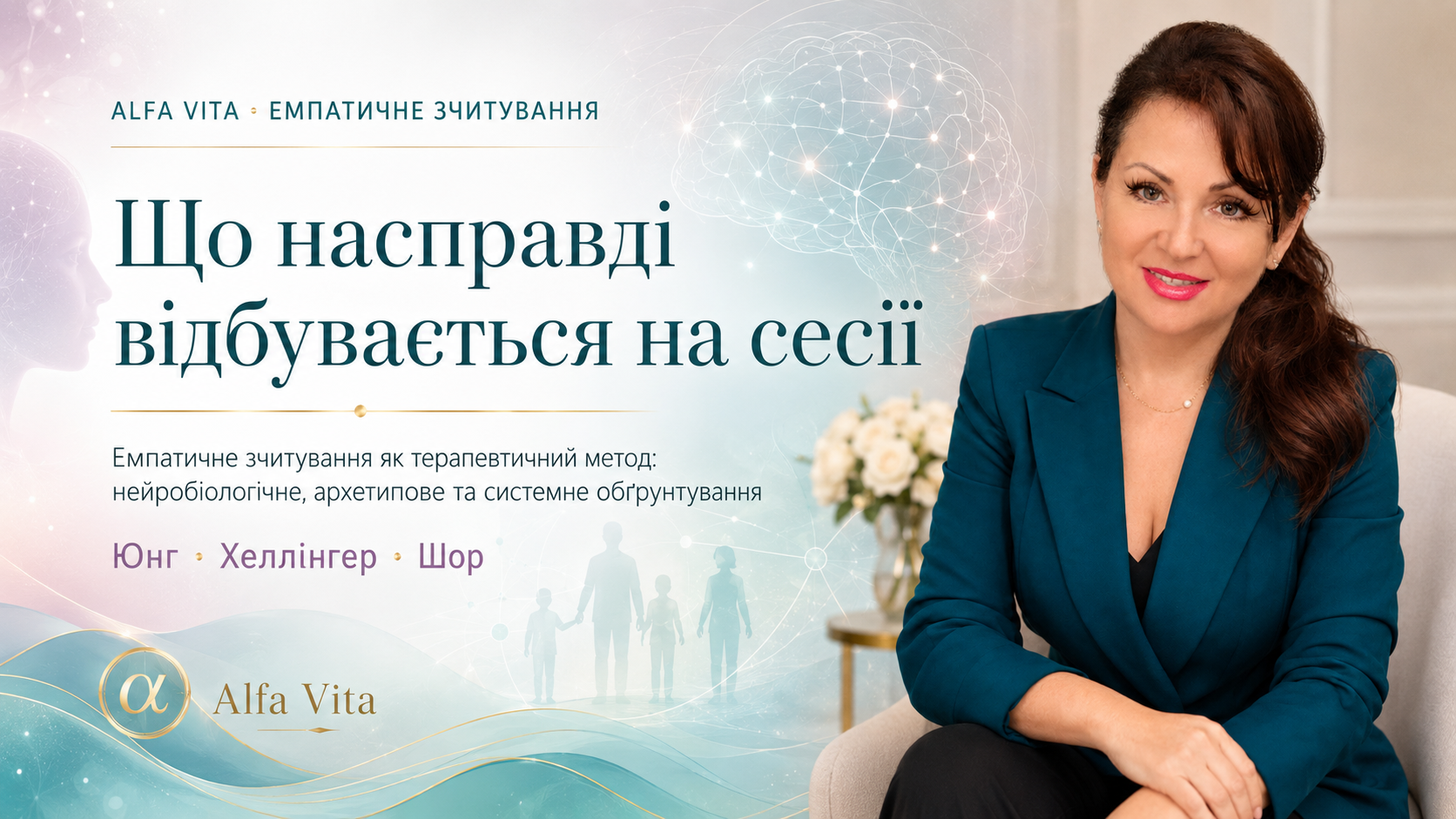
Abstract
This article describes the proprietary method of empathic reading developed in the practice of Alfa Vita, examined through three lines of thought: affective neuroscience (Allan Schore), analytical psychology (Carl Gustav Jung), and systemic family therapy (Bert Hellinger). The article deliberately distinguishes between what is confirmed science and what is practical interpretation and authorial extension of these models — so the reader can see exactly where the research ends and the method begins.
What Actually Happens in a Session
This is the question I get asked most often: what actually happens when I read a client's field?
I enter into resonance and pick up a distortion in the field — a place where something is blocking the free flow of energy, a place words haven't reached yet. I see images the client can't yet name themselves. Sometimes these images turn out to be precise — the client recognizes a detail they hadn't consciously remembered a moment before.
This moment — when the facilitator names an image before the client becomes aware of it themselves — calls for an honest theoretical explanation. Not one that reduces everything to simple suggestion or coincidence. But also not one that passes off interpretation as established scientific fact.
Even back in university, studying psychology and Jung's work, I saw something in these ideas that went beyond academic theory. But it took years of practice for me to really understand how three schools of thought — Jung, Hellinger, and Schore — each touch, in their own way, the same field I work with every day. I want to say this plainly upfront: these three sources carry very different levels of evidence. Schore is confirmed neuroscience. Jung and Hellinger are deep, influential, but not empirically proven models of the psyche. The Alfa Vita method works at the intersection of all three, and I want to show that intersection transparently, rather than blending them into one "proven truth."The Neurobiological Foundation: The Right Hemisphere and Intersubjective Resonance (Allan Schore)
Neuropsychologist Allan Schore is one of the leading researchers in affective neuroscience and intersubjective regulation. His work is directly relevant to understanding empathic reading.
Schore demonstrates that the right hemisphere of the brain is the primary center for processing unconscious affective information, nonverbal communication, and somatic signals. Unlike the left hemisphere — linear, verbal, analytical — the right functions holistically, spatially. It's the right hemisphere that's responsible for what Schore calls implicit relational knowing — implicit relational knowledge transmitted between people outside conscious control.
Schore describes this phenomenon within the framework of right-brain-to-right-brain communication — a direct channel between the right hemispheres of therapist and client, activated in a state of affective attunement. This has been demonstrated experimentally: two nervous systems in direct contact — a mother and infant, a therapist and client in the same room — can enter a state of mutual resonance through tone of voice, gaze, micro-movements, the rhythm of breath.
An important methodological clarification. Schore's research concerns resonance between people physically present with each other, here and now. It isn't about reading specific factual information — names, historical details, events — not present in the direct interaction. When a facilitator in Alfa Vita's practice works with images of this kind, that's no longer a direct application of Schore's research; it's a practical extrapolation, one that uses his confirmed resonance mechanism as a starting point, supplemented by years of clinical experience.
Put simply: heightened sensitivity to a client's affective, bodily state is a neurobiologically grounded phenomenon. The fact that a specific image or detail sometimes emerges from that sensitivity is already an interpretive, practical skill honed over years — not a direct extension of the scientific experiment itself.Analytical Psychology: Archetypes, the Shadow, and the Collective Unconscious (Carl Gustav Jung)
Carl Jung introduced the concept of the collective unconscious — a deeper layer of the psyche shared by all of humanity, home to archetypes: universal patterns of experience expressed through images, symbols, dreams, and projections.
It's important to clarify: this is a philosophical-psychological concept, not an experimentally proven fact by the standards of modern science. It remains influential and clinically useful in the work of many therapists, but it doesn't carry a status comparable to Schore's neuroscience.
In Alfa Vita's practice, the archetypal level is used as an interpretive frame: images that arise in a session often carry not just personal but broader, culturally symbolic meaning — the archetype of the Mother, the Victim, the Exile, the Conqueror. Jung described how unconscious material doesn't disappear simply because it's ignored — it continues to act through projection, symbols, and repeated patterns.
Jung also described the phenomenon of synchronicity — a meaningful coincidence between an inner psychic state and an outer event, without a causal connection in the classical sense. This is useful language for describing moments when an image that arises spontaneously in the work turns out to connect precisely to a client's theme — not as proof of the supernatural, but as an observation worth attention.
The Jungian concept of individuation — the process of becoming a whole person through integrating the Shadow (unconscious, repressed material) — is the theoretical foundation for working with contracts: releasing a subconscious contract can be seen as an act of reclaiming an estranged part of the psyche that had been "bound" by a contract of fear, guilt, or betrayal.Systemic Family Therapy: Ancestral Fields and Loyalty to the System (Bert Hellinger)
Bert Hellinger, the founder of systemic family constellations, described the phenomenon of familial loyalty — an unconscious devotion to the patterns, traumas, and unfinished business of previous generations.
His key idea: what one generation fails to acknowledge and grieve gets reproduced by the next — through repeated behavioral patterns, relationship dynamics, or fate. Hellinger introduced the concept of "entanglement" (Verstrickung): when a member of a later generation unconsciously takes on the fate, feelings, or role of an earlier one.
An important clarification: Hellinger's method of family constellations is an influential and widely used clinical practice, but it lacks the kind of rigorous experimental basis that neuroscience has, and part of the academic psychological community treats it with justified caution for exactly that reason. This doesn't diminish the model's usefulness for understanding patterns — many therapeutic approaches work through narrative and meaning rather than through proven mechanism alone.
Hellinger described how a representative in a constellation can feel the thoughts, emotions, or bodily states of the person they're representing, even without consciously knowing anything about them. In the Alfa Vita method, this principle serves as a working model for understanding why a facilitator sometimes gains access to images from a client's ancestral field before the client becomes cognitively aware of them. This aligns with Hellinger's idea that "the field knows more than any of the participants" — and the facilitator's task isn't to interpret in advance, but to sensitively follow what's emerging.The Mechanism of the Method: Three Levels of Integration
Based on these three theoretical models, the Alfa Vita method of empathic reading can be described as a sequential three-level practice:
Level 1 — Neurophysiological (Schore). The facilitator enters an alfa state — a state of reduced beta activity in which the right hemisphere gains dominant access to processing information. This supports heightened sensitivity to a client's affective, nonverbal signals — bodily, imagistic, and tonal patterns not yet shaped into words. This is a mechanism confirmed by research on interpersonal resonance.
Level 2 — Archetypal (Jung). The images picked up are interpreted through a Jungian frame: do they carry not just personal but broader symbolic meaning? Identifying and becoming aware of such an image is an operation analogous to Jungian Shadow integration.
Level 3 — Systemic (Hellinger). The image identified is placed within the context of the ancestral or cultural system. Possible "entanglements" are identified — unresolved patterns of loyalty keeping the client bound to the system's traumatic experience. The facilitator's work allows the client to become aware of this connection and step out of it.
It's important to acknowledge this openly: the move from Level 1 (neurobiologically confirmed) to Levels 2 and 3 (interpretive models) is a methodological leap. It isn't a single, fully proven scientific chain, but a practical integration of one confirmed mechanism with two powerful, though empirically unverified, models of the psyche.The Contract as a Practical, Operational Concept
In the Alfa Vita method, the "subconscious contract" isn't a metaphor — it's a working concept that can be described in three languages at once:
In Schore's language — as an implicit, bodily encoded behavioral pattern (implicit memory) that activates automatically in relevant contexts;
In Jung's language — as a complex: an autonomous psychic structure organized around an affectively charged core, influencing consciousness outside its control;
In Hellinger's language — as an "entanglement": an unconscious loyalty to the pattern of an earlier member of a family or cultural system.
These are three different descriptive languages for a similar clinical phenomenon — not three independent scientific proofs of the same fact. A contract becomes fixed at every level of a person — from the body and psyche to the subtlest dimension — and that's exactly why working with it requires simultaneous attention to the bodily, symbolic, and systemic layers.
Empathy as a Skill, Not a Mystical Gift
An essential clarification: in the Alfa Vita method, empathy isn't a "gift" in the mystical sense. It's a skill — the activation of heightened sensitivity to another person's bodily and affective signals, consistent with the mechanism of affective attunement Schore describes.
Schore describes empathy as a neurobiological process: the therapist "enters" resonance with the client's somatic and affective state through synchronizing breath, tone of voice, and presence. This synchronization is a condition for deep therapeutic work.
This is what distinguishes the method from a technical application of protocol without genuine presence: without the facilitator's real empathic engagement, heightened sensitivity to the client's signals doesn't arise, and deeper work becomes significantly harder or impossible.Why "The Client Not Knowing" Isn't a Weakness of the Method
A moment often comes up in this work where a client doesn't consciously remember an image or detail that the facilitator names first. This isn't a gap in the method — it's an important methodological marker.
If such an image were a conscious association of the client's, it could be explained by prior preparation or expectation. But when the client has no access to this image in their conscious field — and the facilitator picks it up — from a neurobiological standpoint, this means the information existed in the client's right-hemisphere, not-yet-verbalized memory, somewhere even their own conscious mind has no direct cognitive access to. That's exactly where the facilitator gains access through right-hemisphere resonance.
From a Jungian standpoint, this may be archetypal content held in a deeper layer of the psyche, surfacing only when ego control is lowered — in a relaxed state or through a sensitive intermediary.
From a Hellinger standpoint, this is a classic instance of revealing the "hidden dynamics of the system" — information present in the field that no participant consciously knows, until it surfaces through a sensitive representative.
So "the client not knowing" isn't a gap — it's a sign that the work is happening at a genuinely deep level, not at the level of rational reconstruction.Conclusions and Future Directions
The Alfa Vita method of empathic reading rests on three sources with different levels of evidence:
Schore's neuroscience provides a confirmed scientific mechanism for interpersonal affective resonance — the foundation of the method.
Jung's analytical psychology provides a language for interpreting the symbolic content that arises in the work, and defines the therapeutic goal as the integration of unconscious material.
Hellinger's systemic therapy offers a model for understanding ancestral and cultural patterns of loyalty, and provides grounds for the possibility of releasing them through the work of a system representative.
The essential difference between this method and purely rational approaches is that an empathic facilitator sometimes gains access to a client's subconscious material before the client gains cognitive access to it themselves. This isn't an effect of suggestion — it's a function of right-hemisphere resonance in a state of affective attunement, supplemented by the interpretive models of Jung and Hellinger, which I apply as a practitioner with years of experience.
Further development of the method calls for dialogue with the scientific community, openness to verification through repeated clinical observation, and — most importantly — an ongoing distinction between what's proven and what's practical interpretation in service of a deeper understanding of the person.
Victoria Vysochanska
Regressologist, alfa-state practitioner · founder of Alfa Vita
Specialization: subconscious contracts, ancestral memory, empathic reading
Website: https://alfavita.space
Email: victoria@alfavita.space
Scientific sources:
Jung, C.G. (1959). The Archetypes and the Collective Unconscious. Princeton University Press.
Jung, C.G. (1960). Synchronicity. Princeton University Press.
Hellinger, B. (1998). Love's Hidden Symmetry.
Hellinger, B. (2003). Acknowledging What Is.
Schore, A.N. (1994). Affect Regulation and the Origin of the Self.
Schore, A.N. (2012). The Science of the Art of Psychotherapy.