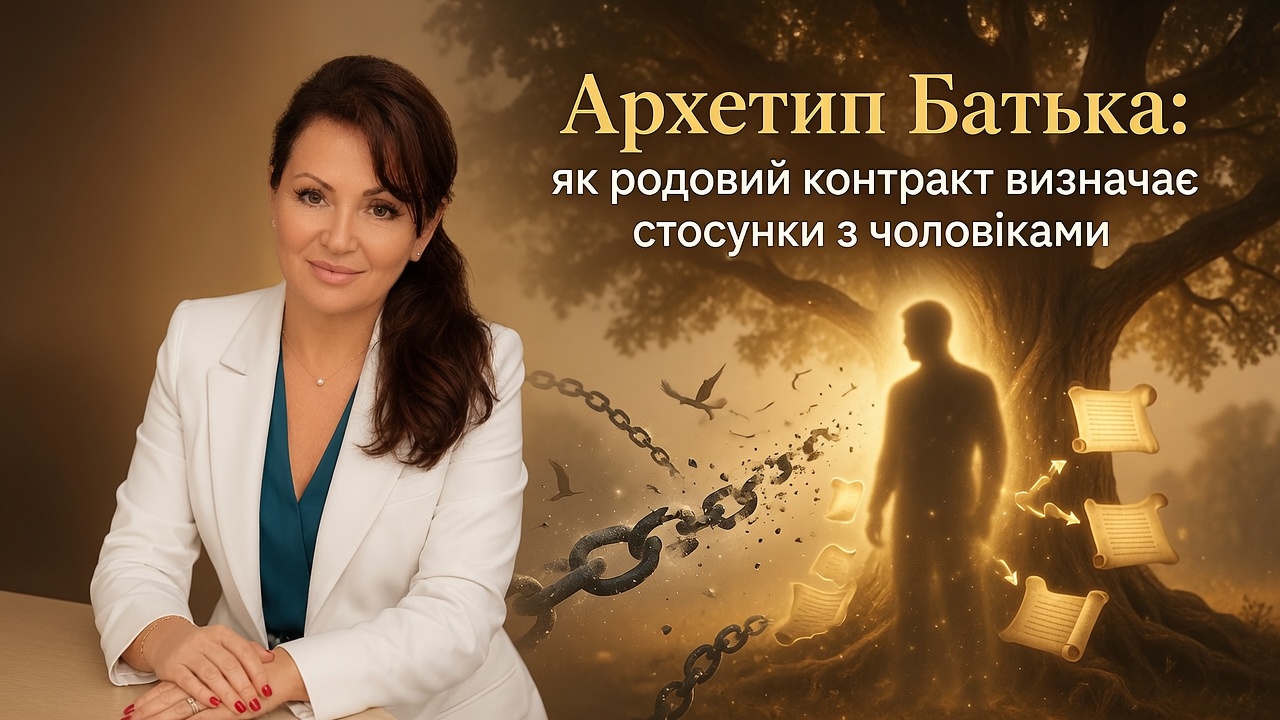
Published: July 7, 2026
What is the Father archetype according to Jung?
Carl Jung described the Father archetype as one of the fundamental, universal images of the collective unconscious — an inner image of order, structure, and authority that forms not only through actual experience with one's father, but through a deeper layer of the psyche shared by all of humanity.
Unlike the Mother archetype, associated with acceptance, merging, and unconditional love, the Father archetype is traditionally linked to discernment, boundaries, and stepping out into the wider world. Jung used the concept of the "father imago" — a subjective inner image formed at the intersection of actual experience and the archetypal structure of the psyche.
An important clarification. This is a philosophical-psychological concept, not an experimentally proven fact by the standards of modern neuroscience. It remains influential and clinically useful, but it carries a different level of evidence than, say, Schore's research on right-hemisphere resonance.
How can a childhood relationship with a father shape a contract for future relationships?
In early childhood, a girl unconsciously absorbs the relationship model she observes between her parents — including the balance (or imbalance) between how much one partner gives and how much they receive. This model can become fixed as a contract that shapes her own relationships with men in adulthood.
Based on observations from the Alfa Vita practice, when a child is present with the parental couple at a moment when the "give-and-take" balance is disrupted — for instance, when one parent consistently gives more than they receive — the child may unconsciously "inherit" that exact model as a template for their own future. This doesn't mean a literal prediction of fate: it refers to a learned, automatic pattern, formed long before a person is able to recognize it or question it.
An important methodological clarification. This is an observation from practical work, not a separately verified scientific fact. It aligns with a general principle confirmed by research on early development: children form stable internal models of relationships in the first years of life (attachment theory, Bowlby, 1969), which then shape how they build relationships as adults.
Why can't a pattern like this be called "fate" or a "curse" in the literal sense?
What looks from the outside like a repeating, almost predetermined script ("in our family, the women are always unhappy in marriage") is actually a learned pattern — not a metaphysical sentence, but the result of a specific mechanism by which a relationship model gets passed down across generations.
The distinction here matters: believing in fate implies an external, predetermined force a person is subject to. Observation based on working with contracts, by contrast, points to a specific mechanism — a child absorbs the model observed in early childhood and unconsciously recreates it until that pattern is recognized and resolved.
What working with a pattern like this looks like in practice
A recurring scenario shows up in practice: a woman, as she grows up, repeats the relationship model she observed between her parents in childhood — often the very same give-and-take imbalance present in the parental couple. She doesn't consciously recognize this connection: decisions about partners feel like her own, yet the pattern turns out to be remarkably persistent.
Working with a contract like this is aimed at reaching the original moment — often from early childhood — when the model was first "adopted," and resolving it there, rather than only at the level of conscious analysis of current relationships.
An important distinction. This is a practical observation and method grounded in clinical experience, not a separately controlled study. The Jungian framework of the Father archetype is used here as an interpretive language for describing this mechanism, not as a literal metaphysical claim about a predetermined fate.
Four archetypal qualities of the inner Father image
In Jungian tradition, a healthy, integrated Father archetype is associated with several qualities:
Wise guidance — the ability to see a situation as a whole and discern which choice leads to genuine well-being rather than just temporary comfort.
Protective strength — the ability to set boundaries and protect one's own time, energy, and goals.
Creative persistence — the ability to see something through once the initial enthusiasm has faded.
Grounded confidence — a deep sense of one's own worth that doesn't depend on comparison with others.
When actual experience with one's father was traumatic — absence, suppression, criticism — access to this inner archetypal resource can become blocked, and that's exactly why the inner voice may sound not like a supportive presence, but like a critical judge.
Frequently Asked Questions
Does this mean my fate is entirely determined by my parents' relationship?
No. This is a learned, not a metaphysically predetermined, pattern. Recognizing the mechanism and working with the original moment it formed can change what looked like an unchangeable script.
Does the Father archetype only apply to relationships with a biological father?
No. Jung described this as a broader, archetypal image that can also form through other significant male figures — a grandfather, a teacher, a stepfather.
Is the idea of an "ancestral contract for unhappy relationships" scientifically proven?
It's an interpretive framework from the Alfa Vita practice, grounded in clinical experience and using Jungian archetypal language as a theoretical foundation, not a separately verified scientific fact.
Can this pattern be changed on your own?
Partial awareness is possible through self-reflection on recurring patterns in your own relationships. Deeper work with the moment the contract formed usually benefits from a practitioner's support.
Scientific sources:
Jung, C.G. (1954). The Development of Personality. Princeton University Press.
Jung, C.G. (1959). The Archetypes and the Collective Unconscious. Princeton University Press.
Bowlby, J. (1969). Attachment and Loss. Basic Books.
About the author:
Victoria Vysochanska — Certified Hypnocoach, Founder of Alfa Vita. 10 years of practice working with subconscious contracts and ancestral memory, with over 20 years in psychology and personal development.
Alfa Vita offers complementary, non-medical practice and does not diagnose, treat, or provide licensed psychological or medical services.