Published: July 1, 2026
Last updated: July 7, 2026
What Is a Soul Contract?
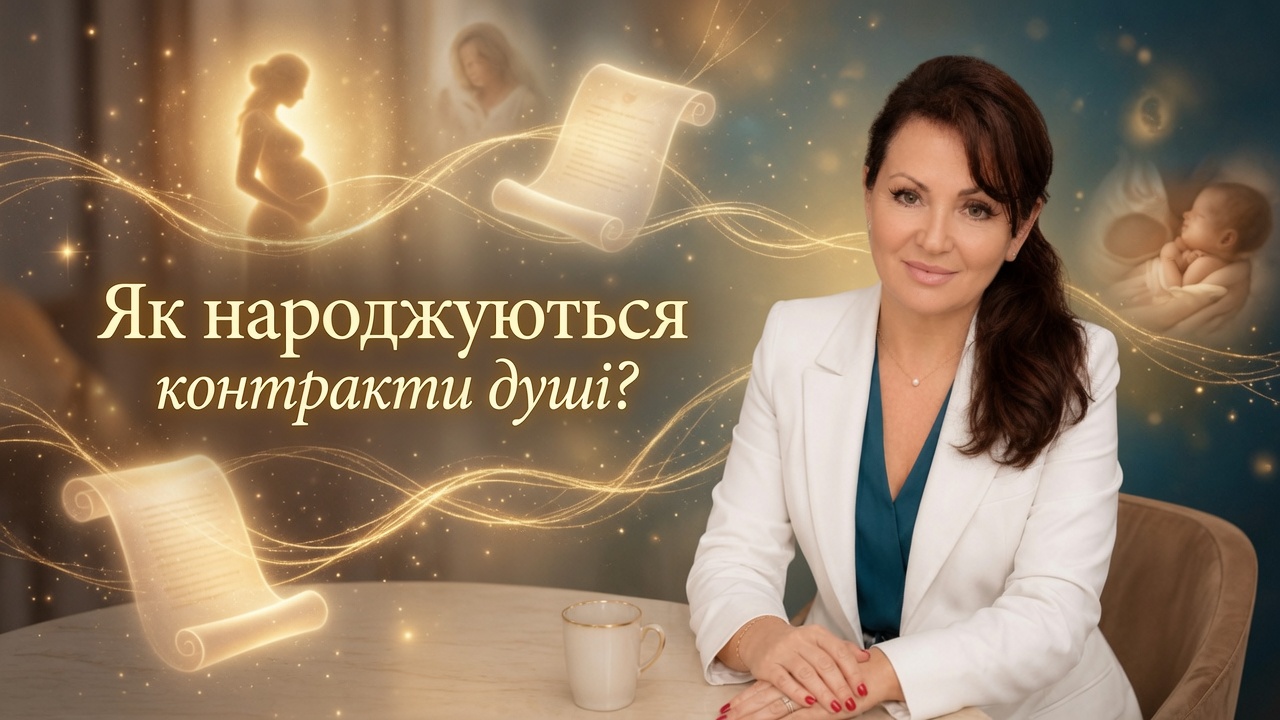
A soul contract is an unconscious decision a person makes at a moment when their basic needs for safety, love, or protection are violated. This decision becomes fixed simultaneously at the level of the body, the psyche, and the subtlest dimension of the person — and begins to govern not just their own life, but the lives of the generations that follow, until someone in the family line becomes aware of it and completes it.
This isn't a memory you can recall through willpower. Most often, it's a decision made long before the person who will eventually feel its weight was even born — which is exactly why it stays invisible for decades, sometimes for centuries. A family usually remembers only the consequence — the pattern that keeps repeating — not the moment it was born.
The Story of One Family Line: Where a "Family Curse" Actually Comes From
In one family, generation after generation, the women repeated the same narrative: "In our family, women never marry the ones they love." It was stated as fact, as a family trait, almost like a hereditary condition — something you simply had to live with.
The explanation was ready too: the great-great-grandmother and great-great-grandfather came from a noble family, chose partners by strict social criteria rather than feeling — and that's just how it had been ever since.
But the real point of origin wasn't where anyone was looking.
In truth, the young woman loved him sincerely — she wanted this marriage with her whole heart. But her parents were against it: he came from the wrong circle, and they refused to give their consent. So the young man held a pistol to his own head and declared: if they didn't give him the woman he loved, he'd shoot himself right there, on the spot.
The girl's parents agreed to the marriage — not by their own choice, but to stop the threat. No one in the family ever spoke of this moment out loud. Not because it was forgotten — but because it was too charged: fear, blackmail, a parent's will crushed, and at the same time, a real, living love that got what it wanted, but through violence. All of it compressed into one silent point. And it was there, in that tension — not in some abstract "family tradition" — that the contract was born: "Even when your heart is right, the path to love runs through blackmail and someone else's pain. Love and violence are inseparable."
Every young woman who came after in that family line carried this decision, without ever knowing its source. She simply felt: to get what her heart wanted, she'd have to pay for it with someone else's pain — or else not let herself want anything at all. And without realizing it, she chose either passionless marriages, where there was nothing to pay for, or relationships already soaked in hidden coercion — what the family called "our fate."
What Does the Science Say About This Mechanism?
Attachment theory (Bowlby, Ainsworth) shows that a child's psyche forms stable internal models of relationships in the first years of life, and these models go on to shape how that person builds relationships as an adult. Mary Ainsworth's classic "Strange Situation" study (1978) confirmed a direct link between childhood attachment style and adult relationship patterns.
Neuroscience (Schore, van der Kolk) shows that intense emotional experience — especially one lived through in a state of strong affect, such as fear or helplessness — gets stored in the right hemisphere of the brain as implicit, preverbal memory (Schore, 2012). Bessel van der Kolk, in The Body Keeps the Score, described how this kind of experience becomes encoded in the body rather than in narrative — which is exactly why it can be passed down not through words, but through atmosphere, tension, and unconscious reactions within a family.
Epigenetics (Yehuda, Dias & Ressler) shows that severe stress can leave a biological trace passed on to descendants. Rachel Yehuda's 2016 study found altered stress markers in children of Holocaust survivors, even though they hadn't experienced the trauma themselves. A 2014 study by Dias and Ressler on mice showed that a fear response to a specific stimulus was passed down across generations through epigenetic changes in reproductive cells.
Systemic work (Hellinger) describes how a "charged," unspoken moment like this in a family line can keep later generations bound to the pattern through unconscious loyalty to the system — even when no one consciously knows the original cause.
An important clarification. These studies confirm general mechanisms: how attachment forms, how intense emotional experience is stored, which biological stress markers can be passed to descendants. The specific family story above is an illustration of how such a mechanism might look in practice — not a direct extension of these studies themselves.
How a Contract Loses Its Power
Notably, not every young woman in this family line lived out the same script to the end.
One of them, having grown up surrounded by the same words about "the family's fate," stopped one day and told herself something different: I choose happiness. Better to be alone than to live with just anyone. She didn't fight her family or make some grand declaration — she simply stopped automatically carrying out a decision that had never truly been her own.
In Hellinger's systemic work, there's a concept of a family representative — someone in whom the old pattern's momentum comes to a stop, because they consciously or unconsciously take on the role of completion rather than continuation. That's exactly what happened here: she didn't just walk away from the old script — she actively took steps toward what she herself wanted, and eventually met someone with whom she felt real closeness — without blackmail, without a hidden price, without anyone's will being broken for the sake of her happiness.
A contract doesn't disappear simply because someone becomes aware of it. It loses its power when a specific person in the family line lives out a different choice — not out of protest against the past, but out of an honest, hard-won conviction: love and violence don't have to be linked. Her happiness doesn't require someone else's sacrifice.
Frequently Asked Questions
Does this mean I'm doomed to repeat my ancestors' fate?
No. A pattern is passed down as a tendency, not a sentence. Becoming aware of its root cause — and, most importantly, consciously choosing a different path — can stop it from continuing.
Why doesn't anyone in the family remember where these patterns actually started?
The most charged, most painful moments are often the first to be pushed out of a family's memory — precisely because they're too heavy to put into words. What remains is only the consequence, which then gets explained away as "tradition" or "fate."
Can a contract like this be released on your own?
Becoming aware of the pattern and consciously choosing different behavior is an important and achievable first step on your own. Deeper work with material stored in the body often benefits from specialized support.
Is there scientific consensus on the transgenerational transmission of trauma?
The mechanisms of attachment and the bodily storage of intense experience are well documented. The precise mechanism of epigenetic transmission across generations in humans remains a subject of ongoing scientific debate.
Scientific sources:
Bowlby, J. (1969). Attachment and Loss. Basic Books.
Ainsworth, M.D.S. et al. (1978). Patterns of Attachment. Lawrence Erlbaum.
Schore, A.N. (1994). Affect Regulation and the Origin of the Self. Lawrence Erlbaum.
Schore, A.N. (2012). The Science of the Art of Psychotherapy. W.W. Norton.
Van der Kolk, B. (2014). The Body Keeps the Score. Viking Press.
Hellinger, B. (1998). Love's Hidden Symmetry. Zeig, Tucker & Co.
Yehuda, R. et al. (2016). Biological Psychiatry, 80(5).
Dias, B.G. & Ressler, K.J. (2014). Nature Neuroscience, 17.
About the author:
Victoria Vysochanska — Certified Hypnocoach, Founder of Alfa Vita. 10 years of practice working with subconscious contracts and ancestral memory, with over 20 years in psychology and personal development.
Alfa Vita offers complementary, non-medical practice and does not diagnose, treat, or provide licensed psychological or medical services.