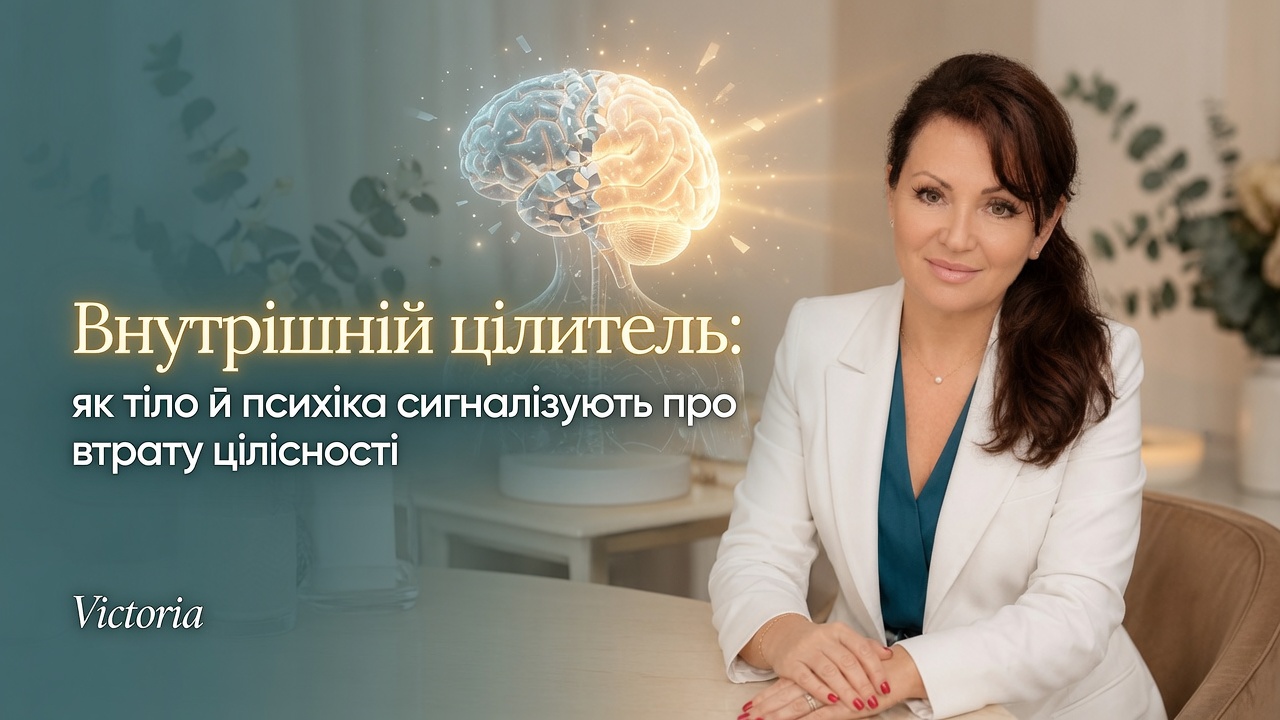
Published: July 7, 2026
What is the "inner healer," from a scientific standpoint?
The inner healer isn't a separate organ or brain structure — it's a metaphor for the body's natural balance-maintaining mechanisms: homeostasis (physiological self-regulation) and interoception (the nervous system's ability to sense and signal the body's internal state).
The body has built-in mechanisms that continuously track its condition and signal any drift from balance — through fatigue, pain, changes in appetite or sleep. This is well-documented physiology, not an esoteric concept.
An important clarification. In the Alfa Vita practice, the concept of the "inner healer" extends further — not just to the physiological level, but to the whole structure of a person: what could be called an inner code or a primary program that seeks wholeness across every level at once — bodily, emotional, relational. This is a philosophical and practical framework from Alfa Vita, not a separately verified scientific fact.
What does it mean to think of a person as a "whole code" seeking to return to balance?
Based on observations from the Alfa Vita practice, a person can be seen as a fundamentally whole structure — a kind of inner code — that, from birth, seeks to stay connected to itself. When part of that wholeness gets "lost" in someone else's script, expectations, or ancestral narrative, the structure itself keeps pulling toward restoring balance.
This means: when a person mistakes someone else's script for their own — beliefs absorbed from family, society, or traumatic experience that actually contradict their natural wholeness — part of that inner code stays cut off from the rest. Symptoms, recurring situations, or inner discomfort, within this framework, aren't random — they're the way the whole structure signals a lost part of itself and reaches to bring it back.
An important methodological clarification. This is an interpretive, philosophical model from the Alfa Vita practice. It isn't an experimentally tested scientific claim — it's a framework grounded in clinical experience that uses the language of "code" and "program" metaphorically, to describe observed patterns, not literally in the sense of computer science or genetics.
What does neuroscience actually show about how early response patterns form?
Research by Allan Schore shows that the first years of life are a critical period, when the right hemisphere is most actively forming the neural connections responsible for a person's ability to regulate their own emotional states for the rest of their life (Schore, 1994).
During this period, before a child even has language, patterns for responding to stress, building relationships, and sensing safety are already taking shape. These patterns operate automatically, below the threshold of conscious control.
An important piece of good news, backed by science. The brain retains neuroplasticity — the ability to form new neural connections — throughout life, not just in childhood. This means early patterns aren't a final verdict; they can be recognized and adjusted in adulthood through new experience and intentional work.
How does a quick, instinctive reaction differ from a conscious choice, at the level of the brain?
Research shows that an immediate response to a threat (real or perceived) is activated by structures involved in fast emotional processing — particularly the amygdala — while conscious analysis of a situation and choice of response rely on the prefrontal cortex, which works more slowly but allows for a considered response rather than an automatic one (LeDoux, 1996).
When a person consistently acts from an instinctive, defensive reaction — even when there's no real threat — this can show up as chronic tension in relationships, finances, or work: excessive control or avoidance in relationships, panicked hoarding or unchecked spending with money, an inability to take risks or, conversely, excessive aggression in a career.
When a person is able to pause between stimulus and response — giving the prefrontal cortex time to process — space opens up for a conscious choice instead of an automatic pattern.
An important clarification. The popular simplified model of "reptilian brain vs. emotional brain vs. rational brain" (Paul MacLean's triune brain theory, from the 1960s) is considered outdated by modern neuroscience — the brain's actual architecture is far more complex and isn't organized into such clean-cut "floors." That's why this article speaks more specifically about the amygdala and the prefrontal cortex, rather than metaphorical "levels of power."
What did Hellinger show about the connection between love and inner order?
Bert Hellinger, the founder of the systemic family constellations method, observed that actions taken out of love for one's family sometimes conflict with healthy boundaries of personal responsibility — and it's this conflict, not love itself, that often lies at the root of repeating family patterns.
According to Hellinger, when a person takes on responsibility out of love that actually belongs to someone else — for instance, rescuing a partner from the consequences of their own choices, or solving an adult child's problems for them — this can sustain dysfunction rather than heal it. Hellinger described this through the concept of "orders": the principle that love functions in a healthy way only within a healthy structure of responsibility, rather than replacing that structure altogether.
An important clarification. Hellinger's method of family constellations is an influential clinical practice, grounded in observation and clinical experience rather than controlled experimental studies comparable to neuroscience. Part of the academic psychological community treats it with justified caution.
What this looks like in practice
A recurring scenario shows up in practice: someone who, out of love for a partner or family member, consistently absorbs the consequences of that person's choices — covering debts, hiding a problem from others, resolving conflicts on their behalf. This often sustains the other person's dysfunctional behavior rather than helping it resolve, while exhausting the person doing the "rescuing."
When a person instead recognizes the boundary of their own responsibility — staying in the relationship, but letting the other person carry the consequences of their own decisions — this often opens space for real change on both sides, though not always without pain.
Frequently Asked Questions
Does the idea of an "inner healer" mean there's literally a separate structure in the brain?
No. It's a metaphor for a set of real physiological self-regulation mechanisms (homeostasis, interoception), extended in the Alfa Vita practice into a philosophical model of personal wholeness.
Does every physical symptom point to a specific psychological cause?
No, that's an oversimplification. The link between chronic stress and physical health is real (psychoneuroimmunology), but specific, one-to-one "translations" of symptoms (for example, "a headache always means X") aren't scientifically supported and don't replace medical diagnosis.
Does neuroplasticity mean any pattern can be changed?
The brain does retain the capacity to change throughout life, but the speed and depth of that change depend on many factors. This is grounds for realistic hope, not a promise of an instant result.
Are Hellinger's "orders of love" a scientifically proven fact?
No, this is an influential clinical concept grounded in observations from practice, not controlled research in the sense used by modern neuroscience.
Scientific sources:
Schore, A.N. (1994). Affect Regulation and the Origin of the Self. Lawrence Erlbaum.
LeDoux, J. (1996). The Emotional Brain. Simon & Schuster.
Hellinger, B. (1998). Love's Hidden Symmetry. Zeig, Tucker & Co.
About the author:
Victoria Vysochanska — Certified Hypnocoach, Founder of Alfa Vita. 10 years of practice working with subconscious contracts and ancestral memory, with over 20 years in psychology and personal development.
Alfa Vita offers complementary, non-medical practice and does not diagnose, treat, or provide licensed psychological or medical services.