Published: July 7, 2026
What is the Karpman Drama Triangle?
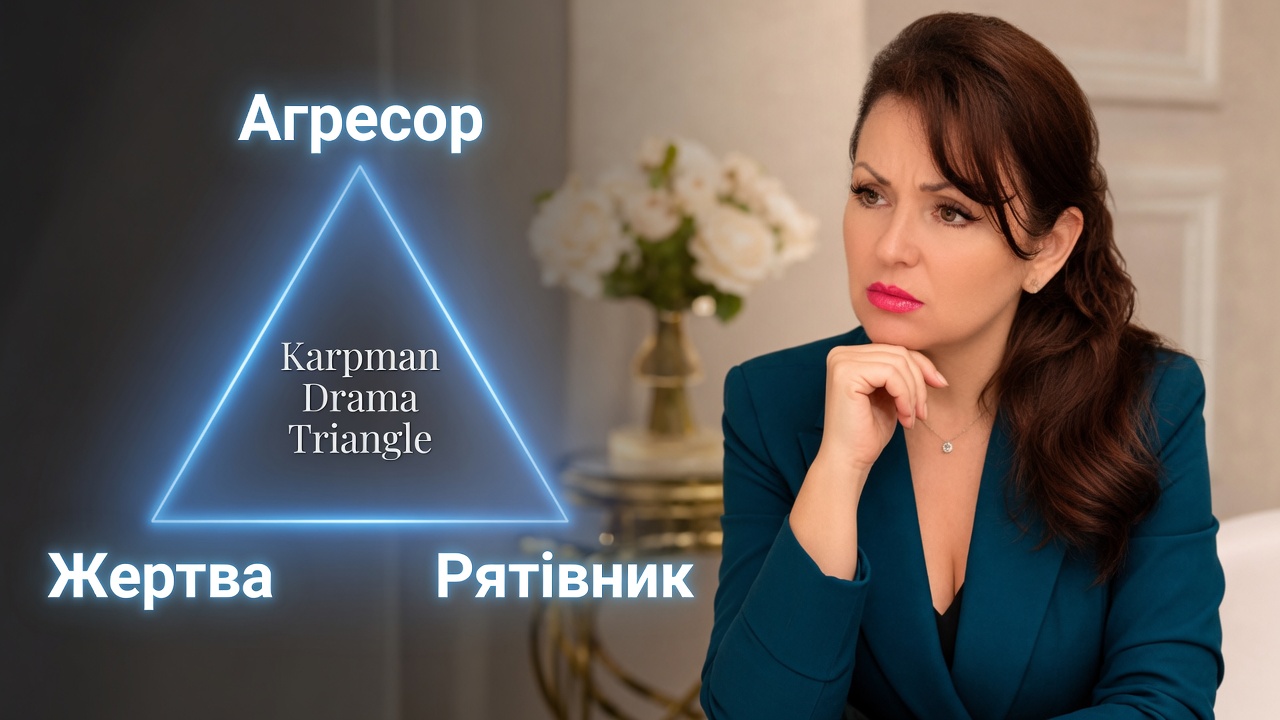
The Karpman Drama Triangle is a model describing three recurring roles in dysfunctional relationships: the Victim, the Persecutor, and the Rescuer. People unconsciously cycle between these roles, and it's this cycling itself — not any single role — that keeps a relationship locked in constant tension.
Psychiatrist Stephen Karpman proposed the model in 1968 as a way to describe recurring patterns in psychological games — building on the framework of Eric Berne, the founder of transactional analysis. The Victim feels helpless and looks for a rescuer. The Rescuer steps in to "fix" the situation, often without being asked. The Persecutor blames and controls. The roles aren't fixed — the same person can cycle through all three in a single evening.
Why is it so hard to break this cycle, even once you understand it?
Repeated cycles of emotional tension and relief activate the same brain reward systems involved in the formation of addiction — which is why leaving a dramatic relationship can come with something resembling physical withdrawal.
A 2010 fMRI study by Helen Fisher and colleagues found that people experiencing romantic rejection show activation in the same brain regions tied to reward and craving as people with substance dependence. This doesn't mean a relationship stuck in the Karpman triangle is literally a drug addiction, but the craving mechanism for emotional highs shares real neurobiological features with the mechanism of addiction.
An important clarification. The popular psychology phrase "your brain gets a cocktail of dopamine, serotonin, and adrenaline" oversimplifies the actual mechanism. Dopamine is tied mainly not to pleasure itself, but to anticipation and the expectation of reward — meaning the brain responds more strongly to unpredictability and the anticipation of the next emotional peak than to the peak itself. This detail matters, because it explains why unstable, dramatic relationships pull at us harder than stable ones do.
Why does unpredictability in a relationship "hook" people more than stability does?
Unpredictable reinforcement — when a reward (in this case, attention, love, reconciliation) arrives irregularly and unpredictably — builds the most persistent behavioral habit of any known reinforcement schedule.
Psychologist B.F. Skinner described this back in the mid-20th century while studying reinforcement schedules: behavior reinforced unpredictably fades out far more slowly and with much more difficulty than behavior reinforced every time. That's exactly why the cycle of "conflict → tension → reconciliation → temporary calm → new conflict" holds onto a person more tightly than stable, predictable relationships without sharp highs and lows.
Researcher Patrick Carnes coined the term "trauma bond" for this phenomenon in the context of abusive relationships — an attachment that forms precisely through the alternation of pain and relief, not despite it.
Why doesn't recognizing the pattern always stop it?
Understanding the mechanism of the Karpman triangle happens at the level of analytical, verbal thinking. But the craving for emotional peaks forms at the level of the brain's reward systems — a deeper layer, less accessible to purely rational control.
This aligns with a broader principle we've touched on in other material: knowledge of a pattern (a left-hemisphere, analytical function) and an automatic behavioral response (tied to deeper, subcortical structures) are, to some extent, different information-processing systems. That's why a person can be consciously aware for years that they're caught in an unhealthy cycle — and still keep going back to it.
What actually keeps a person locked into a role — beneath the neuroscience of reward
In the practice of working with subconscious contracts, the Karpman triangle rarely shows up as an isolated habit on its own. More often, it rests on a deeper layer — a contract that forbids the person from feeling whole or self-sufficient outside a particular role.
The neuroscience of the reward system explains why the drama cycle is physically hard to leave. But it doesn't explain why one specific person spends years choosing the Rescuer role, while another keeps choosing the Victim role. That's no longer a question of the craving mechanism in general — it's a question of a specific, personal or ancestral decision, fixed much earlier in life.
An important distinction. This is no longer a direct extension of Fisher's or Skinner's research — it's an interpretive framework drawn from clinical experience working with subconscious contracts, not a separate, independently verified scientific mechanism.
Within this framework, a role in the triangle is often held in place by an inner prohibition — a decision made long before adulthood: "I only get noticed if I'm rescuing someone," "I only have the right to attention when someone else is suffering," "showing my own wholeness and self-sufficiency is dangerous, because then I'll become unnecessary or alone." A contract like this can be personal (formed in childhood), ancestral (an inherited family role pattern — for instance, "the women in our family always rescue the men"), or professional (for example, the role of the "indispensable rescuer" on a team, which over time becomes someone's only source of self-worth).
As long as this prohibition against self-determination and wholeness stays unconscious, switching roles in the triangle — even with a full understanding of the model — tends to be temporary: a person steps out of one role, only to quickly find a new situation where they unconsciously recreate the same pattern.
How to break the cycle of the Karpman Drama Triangle
Each role in the triangle has a healthy counterpart, described in the "Winner's Triangle" model (Emerald & Choy, building on Karpman's original ideas):
Instead of the Victim — a Vulnerable person who takes responsibility. Acknowledges the difficulty, but looks for a solution rather than a rescuer.
Instead of the Rescuer — a Caring person who asks rather than intervenes. Offers help in response to an actual request, not out of their own need to feel needed.
Instead of the Persecutor — a person who sets boundaries. Expresses disagreement or dissatisfaction without blame or control.
Shifting into these roles takes more than recognizing the model — it requires working with the root cause at a deeper level. As long as the prohibition against wholeness and self-determination remains in force, new behavior will demand constant willpower. Once the contract holding a person in the role is recognized and resolved, healthy behavior stops being an effort and becomes a natural state.
Frequently Asked Questions
Does this mean I'm addicted to drama the way someone is addicted to drugs?
The craving mechanism shares neurobiological features with addiction, but that doesn't mean it's an identical clinical condition. It's a useful metaphor for understanding why leaving a relationship can feel physically difficult — not a sign of addiction in the medical sense.
Can the Karpman triangle only happen in romantic relationships?
No — this dynamic is just as common in work relationships, friendships, and relationships between parents and adult children — anywhere a persistent cycle of control, rescuing, and helplessness takes hold.
Why do I always end up in the same role?
This is often tied to a pattern learned in childhood, or to an inherited family role — a role a person learned to play before they were even able to recognize it. It's not a fixed personality trait; it's a learned survival strategy, held in place at the level of an inner contract.
Is understanding the model enough to break the cycle?
Understanding is an important first step, but the body, automatic reactions, and the deeper contract holding the role in place often require dedicated, practical work — not just analytical awareness.
Scientific sources:
Karpman, S. (1968). Fairy tales and script drama analysis. Transactional Analysis Bulletin, 7(26), 39–43.
Fisher, H.E., Brown, L.L., Aron, A., Strong, G. & Mashek, D. (2010). Reward, addiction, and emotion regulation systems associated with rejection in love. Journal of Neurophysiology, 104(1), 51–60.
Skinner, B.F. (1957). Schedules of Reinforcement. Appleton-Century-Crofts.
Carnes, P. (1997). The Betrayal Bond: Breaking Free of Exploitive Relationships. Health Communications.
About the author:
Victoria Vysochanska — Certified Hypnocoach, Founder of Alfa Vita. 10 years of practice working with subconscious contracts and ancestral memory, with over 20 years in psychology and personal development.
Alfa Vita offers complementary, non-medical practice and does not diagnose, treat, or provide licensed psychological or medical services.