Published: July 7, 2026
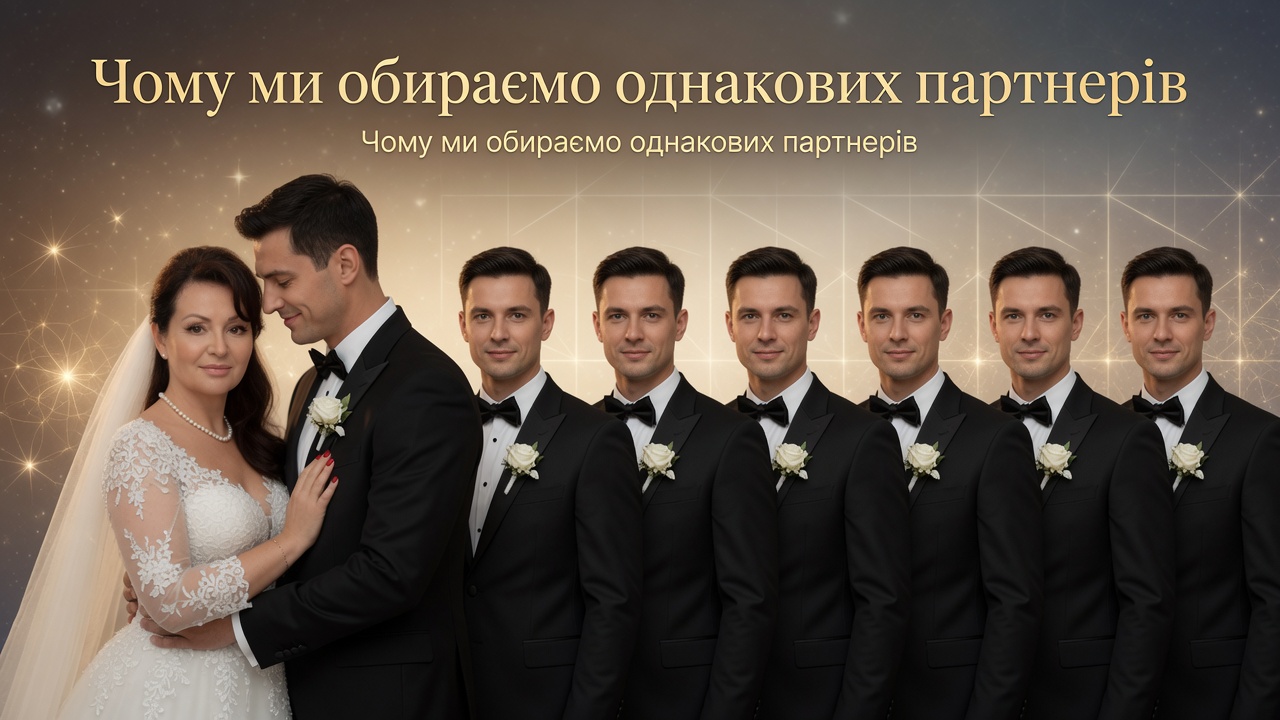
Why does a person end up in similar, often painful relationships over and over again?
People tend to unconsciously choose partners whose emotional traits echo those of significant adults from early childhood — even when those traits seem consciously undesirable. This isn't chance or "bad luck"; it's the result of stable internal relationship models formed in the first years of life.
A person can consciously look for a caring, stable partner — and still repeatedly end up close to someone emotionally unavailable or unpredictable. This looks illogical from the standpoint of conscious choice, which is exactly why it's often written off as "bad luck" or "poor taste in people," when in fact a specific psychological mechanism is at work.
What does attachment theory explain about repeating relationship patterns?
John Bowlby showed that in the first years of life, a child forms a stable internal model of relationships — what's known as an "internal working model" — that shapes their expectations of closeness, trust, and safety in every relationship that follows.
In her classic "Strange Situation" study (1978), Mary Ainsworth found that the attachment style formed with a child's first caregiver predicts, with striking accuracy, patterns of behavior in adult romantic relationships. An anxious, avoidant, or disorganized attachment style in childhood is often recreated in adult relationships — not because a person consciously wants that, but because it's a familiar, predictable pattern, even when it's a painful one.
Why does the familiar feel "right," even when it's harmful?
The nervous system reads the familiar as safe and the unfamiliar as potentially threatening, regardless of whether the familiar pattern is actually good for the person.
This lines up with a principle we've covered in other articles: the brain assesses a new stimulus for uncertainty faster than it can rationally work out whether it's actually safe (Grupe & Nitschke, 2013). That's why a partner with a stable, consistent attachment style — one the nervous system finds "boring" — can feel less compelling than a partner with an unpredictable dynamic that's familiar from childhood, even when that very dynamic causes pain.
How can a contract, not just habit, lie at the root of partner choice?
Based on observations from the Alfa Vita practice, the repeated choice of emotionally unavailable or difficult partners often rests on more than just a familiar attachment pattern — it rests on a deeper decision: a belief that this is exactly what love looks like, or that the person doesn't deserve anything different.
This decision can form in early childhood — for instance, when the only available way to get a significant adult's attention was through anxiety, earning it, or waiting it out. A child absorbs the lesson: "love means fighting for attention," or "to be noticed, I have to be convenient, not real." In adulthood, these early conclusions go on unconsciously shaping which type of partner feels "compelling" and which just feels uninteresting.
An important methodological clarification. This is an interpretive model from the Alfa Vita practice, extending the scientific theory of attachment into a deeper notion of a contract. It's a practical observation from clinical experience, not a separately verified scientific fact.
Why doesn't recognizing the pattern always stop it from repeating?
A person can see clearly that they keep choosing the same type of partner over and over, and still repeat that choice — because recognition happens at the level of analytical thinking, while the attachment pattern itself is fixed deeper, in bodily, preverbal memory.
This aligns with a general principle we've covered in articles on self-sabotage and the Karpman Drama Triangle: knowledge of a pattern and an automatic emotional response are, to some extent, different systems. That's why a person can understand the mechanism behind their own partner choices for years and still feel an irresistible pull toward the familiar — even painful — type of relationship.
How can this pattern connect to an ancestral context?
Sometimes the repeated choice of difficult partners turns out to be connected not just to a person's own experience, but to a broader family pattern — for instance, when a family held a persistent relationship model that the women or men in that line kept recreating across generations.
Based on observations from practice, this aligns with Hellinger's systemic principle of loyalty to the family system (Hellinger, 1998): a person may unconsciously recreate a family relationship script, even without knowing the details of earlier generations' histories — almost as if staying loyal to a familiar model rather than choosing their own path.
Frequently Asked Questions
Does this mean I'm doomed to repeat the same type of relationship forever?
No. This is a learned pattern, not a fixed one. Recognizing the mechanism and working with the root cause can change what looked like an unshakable pattern.
Can I change the type of partner I'm drawn to through conscious decision alone?
A conscious decision is an important first step, but if a deeper attachment pattern or contract lies underneath, that decision alone is often not enough for lasting change without deeper work.
Why am I not attracted to "good," stable partners?
This is a common experience: the nervous system can read stability as "boring" simply because it's unfamiliar, not because stable relationships are inherently worse.
Is the idea of a "contract for repeating partner choices" scientifically proven?
Attachment theory is well supported by research. The idea of a deeper contract holding this choice in place is an interpretive model from the Alfa Vita practice, grounded in clinical experience, not a separately verified scientific fact.
Scientific sources:
Bowlby, J. (1969). Attachment and Loss. Basic Books.
Ainsworth, M.D.S. et al. (1978). Patterns of Attachment. Lawrence Erlbaum.
Grupe, D.W. & Nitschke, J.B. (2013). Uncertainty and anticipation in anxiety: an integrated neurobiological and psychological perspective. Nature Reviews Neuroscience, 14(7), 488–501.
Hellinger, B. (1998). Love's Hidden Symmetry. Zeig, Tucker & Co.
About the author:
Victoria Vysochanska — Certified Hypnocoach, Founder of Alfa Vita. 10 years of practice working with subconscious contracts and ancestral memory, with over 20 years in psychology and personal development.
Alfa Vita offers complementary, non-medical practice and does not diagnose, treat, or provide licensed psychological or medical services.